
There are a ton of blog posts, academic articles and even youtube videos on all sorts of statistical mistakes that are made in research, ranging from academic drug discovery to A/B testing of websites. Some of them talk about P-hacking. Others talk about sample sizes and statistical power. And then of course there’s all the logical fallacies that involve statistical interpretation. However one that I feel is very underrepresented is around the chaining of correlations.
The typical mistake here is that A is correlated to B, and B is correlated to C, so therefore A must be correlated to C. Nothing about causations, no claim of shared mechanisms or anything like that, just simple correlations.
This is most easily demonstrated with some simple unit vectors on a circle. A correlated to B and B correlated to C doesn’t mean A correlated to C. Even with quite a high correlation of 0.7 on both sides, there’s still no guarantee of any correlation at all. And if the sum of the arc-cosine of the correlations adds up to more than 90 degrees, they could even end up with a negative correlation.
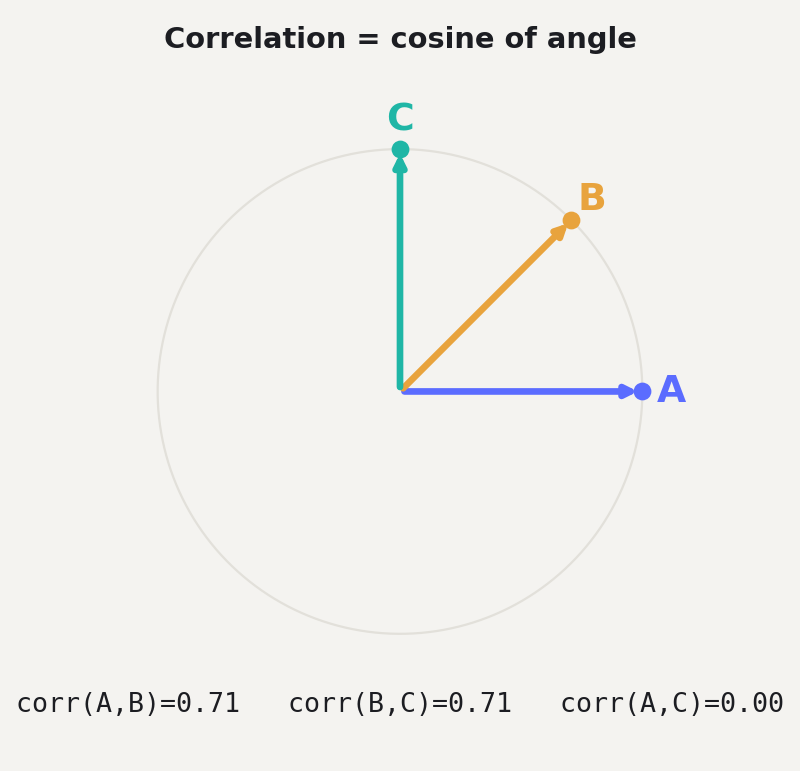
Of course, just because something isn’t completely correct, doesn’t mean it isn’t useful. If we have fairly high correlations, then there ends up being a much smaller manifold for the data to live on, so the probability of there being a correlation between A and C gets larger, but as the first diagram shows, the worst case is the two adding up perfectly in the same direction.
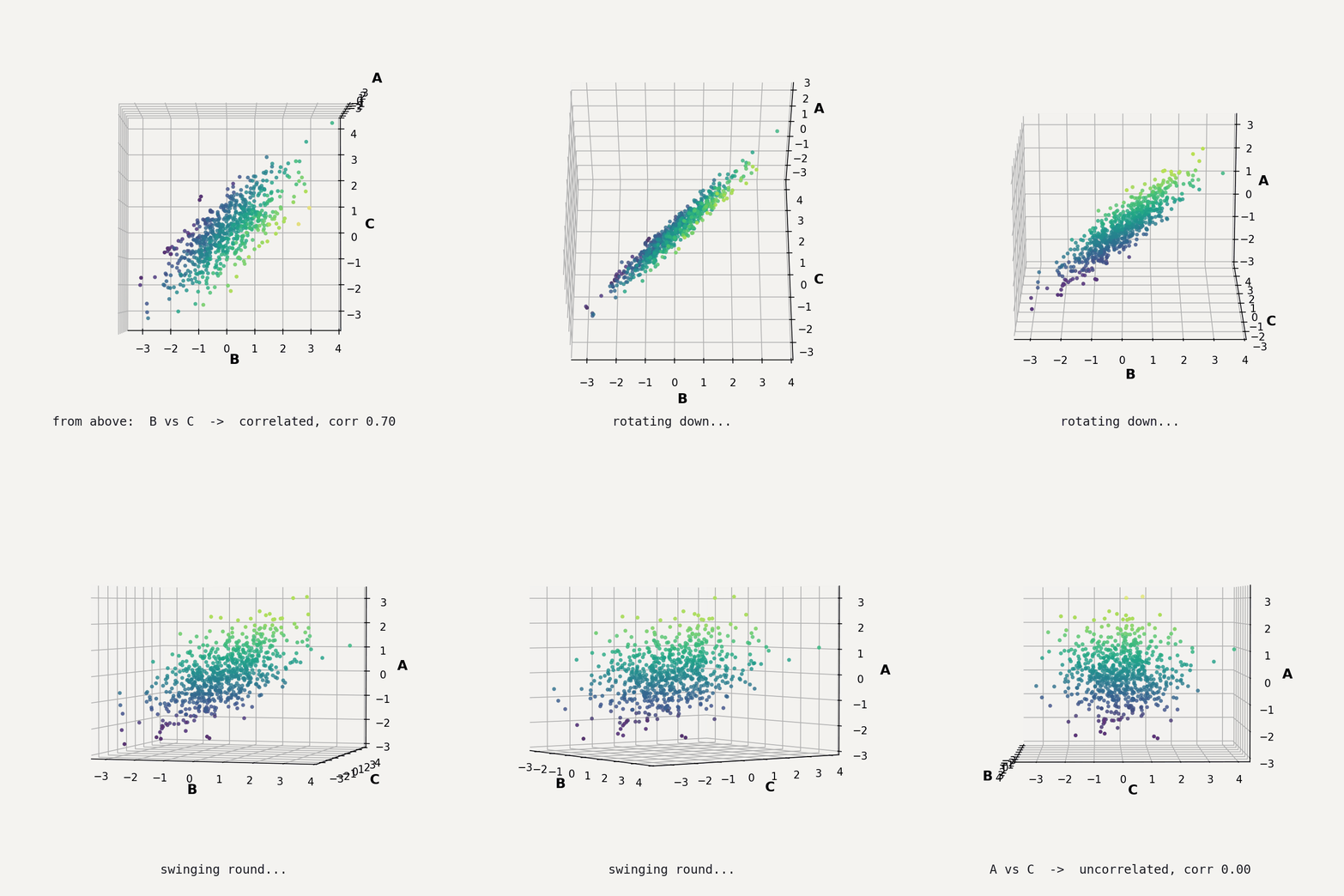
Note that this doesn’t hold for variables where causation is established. If you have identified and proved causative mechanisms for the entire chain, then normal product rule for correlations applies, 0.71 x 0.71 = 0.50 correlation. But having causation established for just one of the links doesn’t help.
So, be smart around it. If you are on safari and want to know where to see lions, and lions go to the waterhole when it’s dry, and it hasn’t rained for a while, then yeah, that’s a good place to go look. But if you want to spend a trillion dollars on drug discovery, then “amyloid plaques are found in Alzheimer’s patients” needs a high correlation itself, and preferably causative proof, before you even get to the correlation and causative requirements of “this drug reduces amyloid plaques.” And that’s before even getting to causative fallacies like “the reduction of plaques via this drug will impact the same mechanism that causes Alzheimer’s”.
Appendix 1: In case the first picture doesn’t make it clear enough, this can be chained with as many correlations as you want
Appendix 2: Another thing to keep in mind, particularly around real-world examples, is that things often aren’t linear. More features correlates with more customers, more customers correlates with more revenue, but too many features might just drive your customers away because your product gets too complicated.